
A Scandinavian Experiment in Letting Go
On allow outcomes to be shaped by the natural forces of time, place, and community.

For most funders, investments come with strings. Deliverables, outcomes, and reports are standard practice—a hedge against waste.
But what happens when we loosen the strings and allow outcomes to be shaped by the natural forces of time, place, and community?
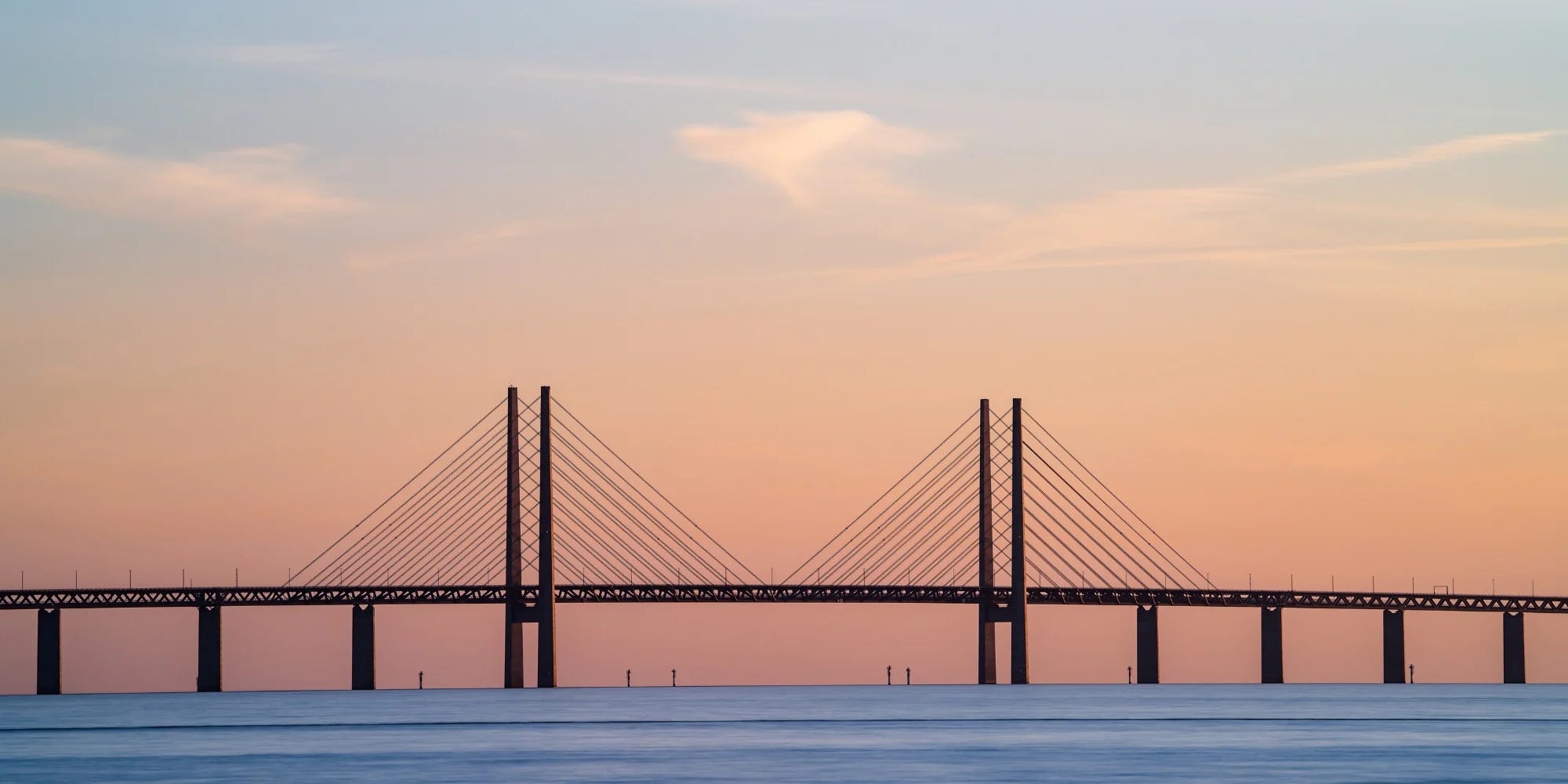
In a coastal city on the far side of Europe’s largest suspension bridge, funders tried something different. They pooled resources into a loose collective, stepped back from the spotlight, and offered people around the world a month of unstructured time and community to explore an idea.
No KPIs. No deliverables. No reports. Just freedom to explore.
I’m inspired by this modern approach to making a difference on the issues shaping our communities and our world. I invite you to read on, and share with a friend so they can subscribe.
—Patrick Diamond
A Scandinavian Experiment in Letting Go
What happens when funders give people time, space, and freedom to explore?
The Malmö Residency takes shape as a month-long invitation for a handful of people from around the world to live and work in Malmö, Sweden.
Borrowing from the tradition of artist residencies, it creates space for reflection and exchange—but extends it into technology, entrepreneurship, and community life.
Residents are entrusted to make the most of their time, their networks, and the connections the city has to offer.
Malmö, Sweden’s third most populous city, is already accustomed to doing things differently.
With half its population under 35 and 186 different nationalities represented, it’s fitting that Malmö would adopt an interdisciplinary, multicultural approach to shared prosperity.
Economically, it’s home to 39,000 companies—mostly small and medium-sized businesses that thrive on collaboration. The Malmö Residency is shaped by these demographics.
By structuring its backers into a loose collective, the residency gains the strength of many voices instead of following the lead of a single funder.
By removing credit, power dynamics are dispersed and the overhead costs and benefits are shared. This radical approach encourages connections to develop organically across Malmö’s diverse business community.
Interdisciplinary Cohorts Ignite Creative Tension
Despite its experimental structure, competitive selection and focused themes maintain a sense of intention and shared purpose.
Looking towards the city’s needs, the collective called for applicants interested in five key themes: AI and Emergent Technologies, Food Innovation, Wise and Digital Cities, Cultural and Creative Industries, and Green Transition.
In its first year, the Residency’s call for applicants drew international interest, and 860 people from 88 countries applied.
After careful review, eight residents packed their bags for Malmö from across Finland, Nigeria, Japan, Bulgaria, Germany, the Netherlands, and the UK. Professors, artists, entrepreneurs, scientists, and writers came together in one place—an intentionally eclectic mix designed for a spillover of ideas: the hallmark of a healthy innovation ecosystem.
This combination of focused themes, competitive selection, and an intentionally loose structure creates rare creative tension.
Perspective shifts emerged from interdisciplinary approaches to shared space and time—insights that continue to ripple well beyond the residency itself.
Could New England adapt the Malmö Residency’s radical structure?
For better or for worse, Northern New England may share more in common with neighbors across the Atlantic than the rest of the United States.
Our communities are remarkably rural, our populations aging, and our economies and daily life are rooted in the tradition of small businesses and entrepreneurship.
The key difference is in how we support risk-taking.
Nordic countries lower the cost of creativity by investing in community and wellbeing—offering economic safety nets that create social and economic security. This collective approach allows new ideas and businesses to flourish.
In my community of Maine, and across much of the United States, we rely heavily on the profit motive alone to catalyze prosperity—raising the price of admission for those with new ideas for creating healthy, prosperous communities across the state.
And yet, with fewer than 1.5 million people, Maine is not so different from smaller Nordic countries. In fact, our per-person economic output and income place us in the same ballpark as Finland.
Maine should aspire to act more like a country shaping its own future rather than shrinking into the margins of an economy designed to benefit the few over the many.
Our opportunity lies in reimagining Maine as a place where creativity and craft are not only preserved, but elevated into a distinct brand of quality recognized around the world.
By adapting modern funding models like this residency, we can rejuvenate our communities, and give Maine the confidence to act with the ambition of a small nation. The task before us is to lead in our own way—rooted in what makes this place unique.
I recently visited Malmö to see the Residency firsthand and learn how Nordic models of creativity and community work in practice. The city’s openness offers lessons for Maine, where similar values run deep.
If Malmö shows what happens when funders let go, Maine can show what’s possible when small places think like nations.